
Vineyards
The Diego Mathier Family's Vineyards
Over the years, the Mathier family has acquired approximately 45 hectares of exceptional vineyards. Viticulture has evolved over time. Even though there are now technological advancements to make the work easier, vineyard work still requires a great deal of manual labor.
Terroir
Perfect climatic conditions for top-quality wine
In the Rhône Valley in Valais, from Turtmann to Chamoson, we find perfect conditions for growing first-class red and white wines.
hectares of prime vineyards
Average precipitation per square meter
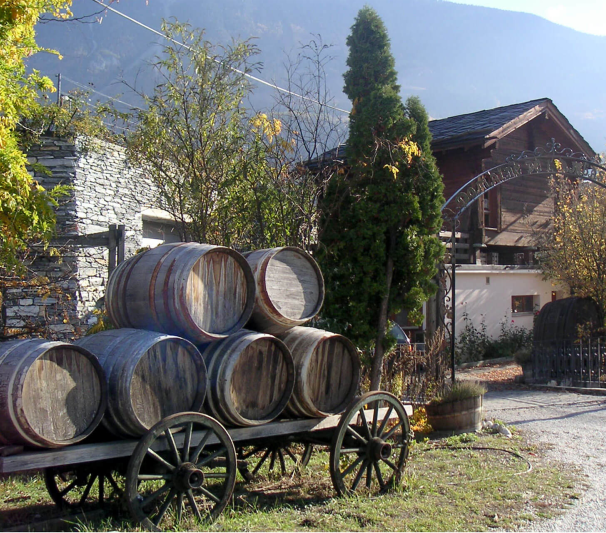
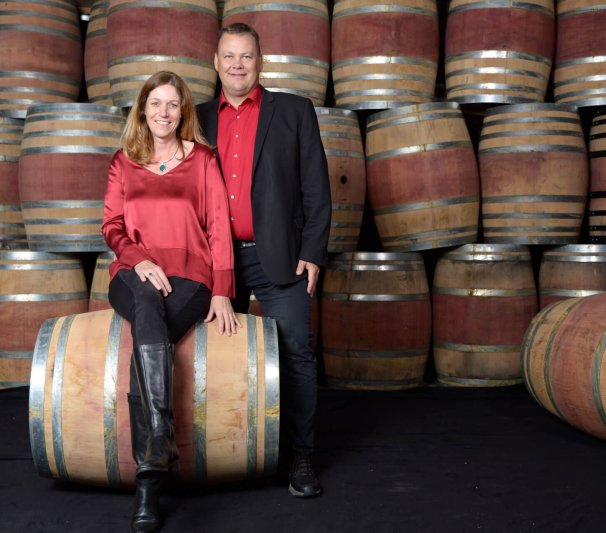
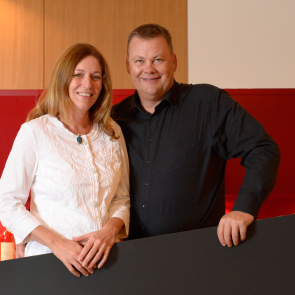
"Of course, on the one hand, we benefit from the climatic conditions provided by the Rhône Valley—with the river as the source of all vegetation at the valley floor—as well as the consistently prevailing, gentle Föhn wind."
Diego Mathier
Vineyards
The Best Vineyards in Valais
Discover a selection of our vineyards between Turtmann and Chamoson
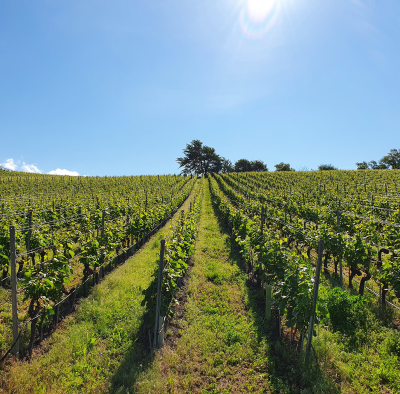
Domaine de l'Ambassadeur
Pinot Noir from Salquenen
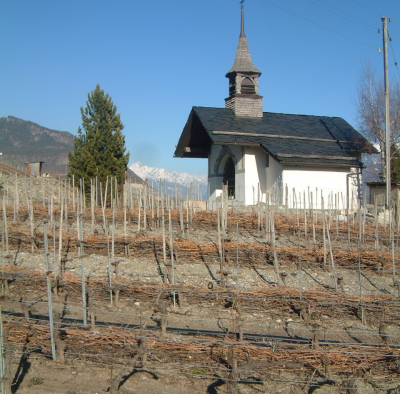
Wyler Molignon
Chasselas
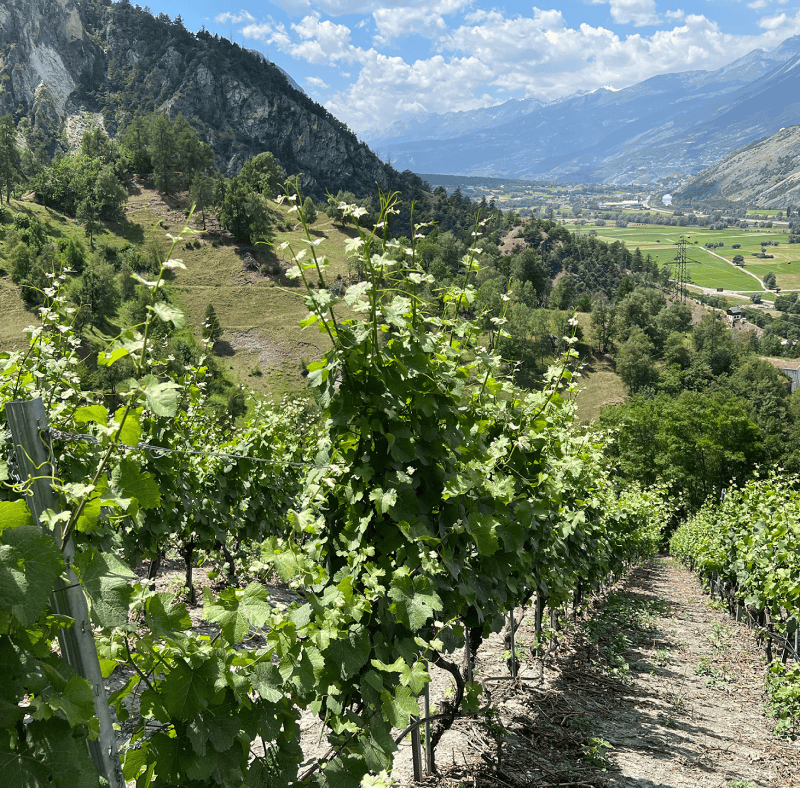
Steep slopes of Turtmann
Heida
“From Vitiswiss (Swiss Association for Sustainable Development in Viticulture), which has set as its goals, among other things, the production of healthy grapes, the preservation of landscapes and biodiversity, and the conservation and promotion of natural resources and energy—we have consistently received the highest award for our work for many years.”
Diego Mathier
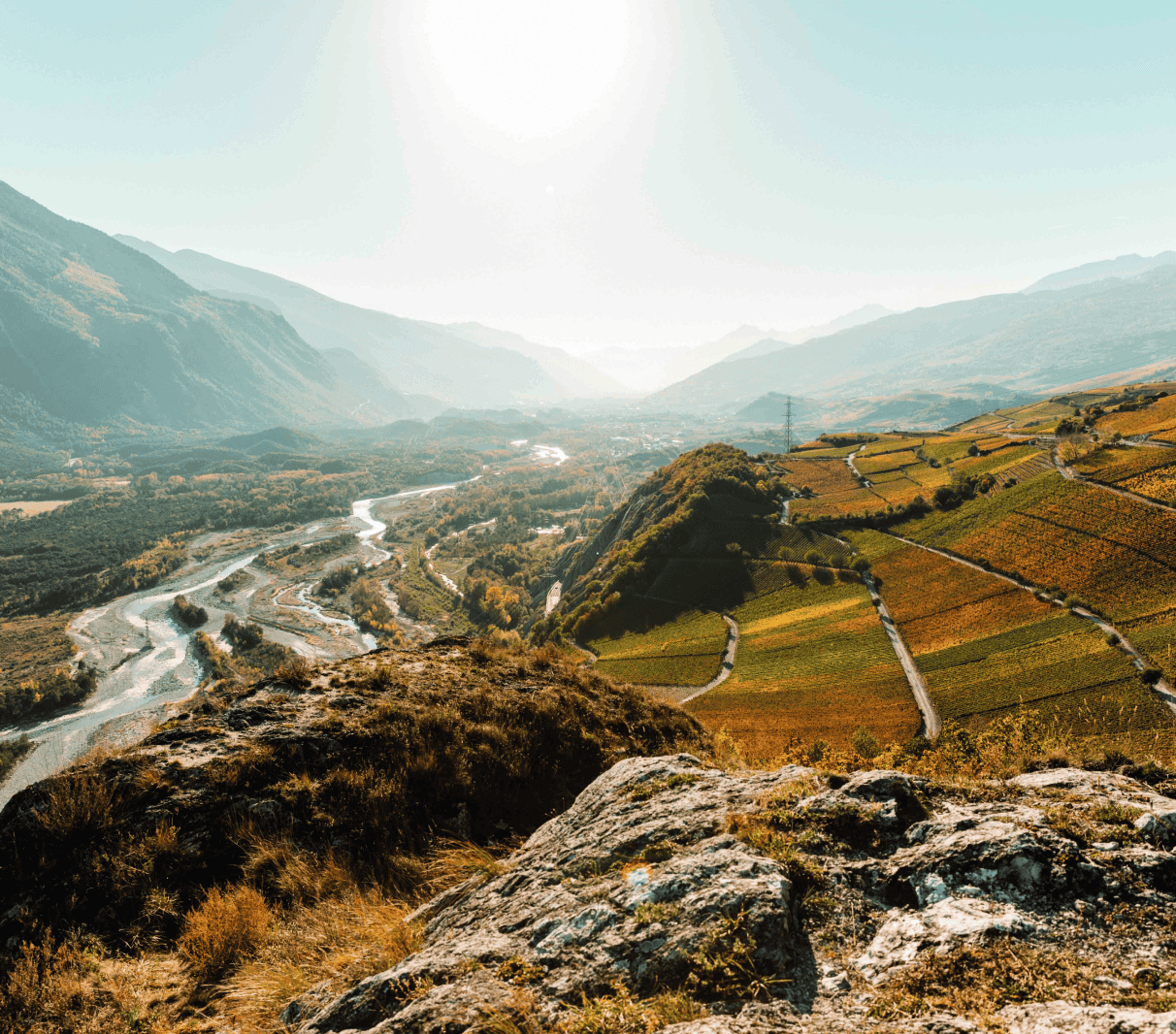
Valais Rhône Valley
The Rhône—the cradle of viticulture in Valais
The Rhône Glacier, which decisively shaped the valley during its last glacial advance (115,000 to 15,000 years ago), has evidently been kind to modern-day winemakers. From moraine deposits near Chamoson to soils with a high slate content, to humus-rich and loamy soil types, and even calcareous subsoils, there is an almost paradisiacal diversity that delights Diego Mathier. “Our precious legacy of outstanding vineyard sites, paired with this almost paradisiacal diversity of soil types—unmatched anywhere else in Switzerland—allows us to experiment with grape varieties in a positive way, with the goal of creating the perfect moment of enjoyment in the wine glass. In addition, we divide the Valais climatically into two regions and can further tailor our cultivation strategy accordingly. For example, from the Upper Valais to Chamoson, precipitation is very low, whereas we find that from Leytron to Martigny, comparatively much more rain falls.”
How We Match Grape Varieties to Their Respective Terroirs
Salgesch
Salgesch and its distinctive landscape, with its approximately 50 hills between Leuk and Siders, were formed about 13,000 years ago by one of the largest landslides in the Alps. During this event, no less than one cubic kilometer of rock broke loose below the Varenalpe and thundered down into the valley. The result is exceptionally calcareous soil, on which red wine in particular (85% of the vineyard area is dedicated to red wine), especially Pinot Noir (70% of the red wine vines are dedicated to Pinot Noir alone), Gamay, and Cornalin. This is one of the main reasons why Salgesch is often referred to as the Pinot Noir mecca of Switzerland.
Sierre
Sierre offers a mix of soils that are very rich in humus and very hard, and, combined with the region’s intense sunlight, is ideally suited for growing Chasselas. Successful winemaker Diego Mathier primarily grows the grapes here for his Fendant du Ravin and Ville de Sierre.
Wiler Molignon
The Wiler Molignon features slate-rich soils that impart a lovely minerality to the wines. These are ideal conditions for the Molignon Terre Promise and, thanks to its elevated location, also for the Petite Arvine Les Pyramides, which has already received numerous top international awards, not least because of this combination of grape variety and terroir.
Sion
The area around Sion (German: Sitten), the capital of the canton of Valais, also features excellent slate soils that lend the wines an elegant minerality, making them exceptionally well-suited for growing white wine grape varieties. This is where the grapes for Fendant Ville de Sion thrive, as well as those for the dessert wine Ermitage Rubin (near Leytron). And in the village known as La Folie, Pinot Noir vines over 100 years old thrive, and their grapes are vinified into Pinot Noir La Folie.
Turtmann
Turtmann, located east of Salgesch, has soils that are very loamy—and therefore impermeable to water. Savagnin blanc grapes are the primary variety grown on this terroir, and they are then enjoyed as Heida in the glass.
Vétroz
The municipality of Vétroz is home to black slate soils, which serve as the foundation for growing the grapes from which Switzerland’s best winemaker of the decade primarily produces the Amigne de Vétroz.
Chamoson
Chamoson, with its moraine deposits and gravelly soils, offers ideal conditions for the grapes used in the Johannisberg Weidmannstrunk and the Ambassadeur Fumé Gros Rhin. The gravelly soils serve as a dual source of heat. While they store the sun’s heat during the day and release it to the plants overnight, they also reflect sunlight during the day, which then falls, so to speak, from below onto the plants and their vines.
Conthey
Conthey, located behind Sion as seen from Salgesch, is a wine-growing region ideally suited for late-ripening grape varieties, as it is home to what are arguably the hottest sites in Valais. The successful winemaker from Salgesch prefers to grow the grapes for his Syrah Diego Mathier here.
Subscribe to the newsletter & enjoy the benefits
Subscribe to our newsletter and take advantage of our great offers.
By clicking “Sign In,” you confirm that you have read and agree to our Terms and Conditions .
Do you have any questions?
If you have any questions or inquiries, please feel free to contact us.
Send us an email, and we'll get back to you as soon as possible.
Phone
Give us a call and speak directly with one of our staff members.
Social Media
Contact us on our social media channels.